
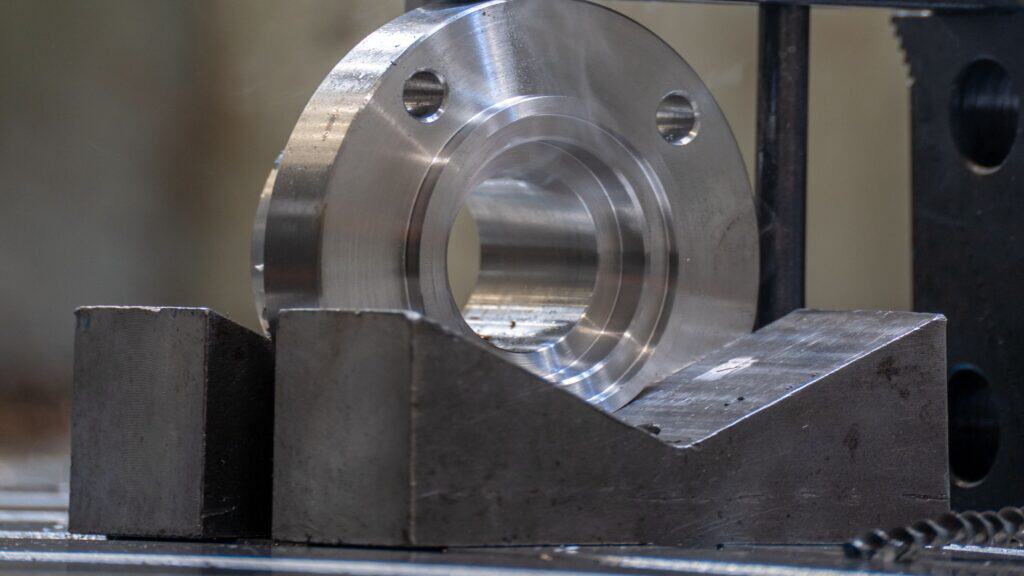
The seven main flange types used in industrial piping are weld neck, slip-on, socket weld, lap joint, threaded, blind and orifice flanges. Selection depends on operating pressure, temperature, pipe size and whether the joint can be welded. This guide explains each type, the standards that govern them, and how to specify flanges for sale in Malaysia.
What Is a Flange and Why Does the Type Matter?
A flange is a mechanical connection that joins two sections of pipe, or joins pipe to a valve, pump or vessel, using a bolted joint with a gasket between two machined faces. Unlike a welded joint, a flanged connection can be dismantled for inspection, cleaning or component replacement.
The type you specify determines three things: the pressure and temperature the joint can withstand, how the flange is attached to the pipe, and how the joint behaves under thermal cycling and vibration.
Getting this wrong is expensive. A slip-on flange installed where a weld neck was required may hold under static pressure but fail prematurely under cyclic loading. A threaded flange fitted in a high-temperature line can loosen as the joint expands and contracts. In refinery, offshore and desalination service, a failed flange joint means unplanned shutdown, not just a replacement part.
The 7 Types of Flanges Used in Industrial Piping
1. Weld Neck Flanges
A weld neck flange has a long tapered hub that is butt-welded to the pipe, with the flange bore matching the pipe bore. This produces a smooth, continuous flow path and transfers stress from the flange into the pipe wall. It is the preferred type for high-pressure, high-temperature and cyclic service.
The tapered hub gradually redistributes stress at the transition between flange and pipe, which is why weld neck flanges outperform every other type under fatigue loading, thermal cycling and vibration. They are standard in refinery process piping, high-pressure steam lines and critical offshore systems.
Limitation: the most expensive type, and the bore must be specified to match the pipe schedule. A weld neck flange bored for SCH 40 will not mate correctly with SCH 80 pipe, creating a step in the flow path.
2. Slip-On Flanges
A slip-on flange slides over the outside diameter of the pipe and is fillet welded on both the inside and outside. It costs less than a weld neck flange and is more forgiving during alignment, since the flange position can be adjusted before welding.
Slip-on flanges are widely used in lower-pressure utility, water and general service piping where cost and installation speed matter more than fatigue performance. They are common in Class 150 and Class 300 applications.
Limitation: markedly lower fatigue life than a weld neck flange, because the double fillet weld creates a stress concentration rather than a smooth transition. Not recommended for cyclic loading, thermal cycling or high-temperature service.
3. Socket Weld Flanges
A socket weld flange has a recessed socket into which the pipe is inserted, then fillet welded externally. It is used almost exclusively on small-bore, high-pressure lines, typically NPS ½ to NPS 2 and sometimes up to NPS 4.
The internal weld is eliminated, which makes fabrication simpler on small diameters. An expansion gap of approximately 1.6 mm must be left between the pipe end and the socket shoulder to prevent cracking as the weld cools and the joint expands in service.
Limitation: the socket creates an internal crevice where the pipe end meets the flange. That crevice traps fluid and promotes crevice corrosion, which rules socket weld flanges out for corrosive media, high-purity service and most food or pharmaceutical applications.
4. Lap Joint Flanges
A lap joint flange is used with a stub end. The stub end is welded to the pipe, and the flange sits loose behind it, free to rotate. This makes bolt hole alignment straightforward and is a significant advantage on systems that are dismantled frequently for cleaning or inspection.
The cost advantage is the real reason engineers specify them. Only the stub end contacts the process fluid, so only the stub end needs to be manufactured in an expensive alloy. The backing flange can be carbon steel. On a stainless or duplex system, that can substantially reduce the cost of every flanged joint.
Limitation: lower pressure capability than weld neck flanges, and not suitable for high-stress or cyclic applications. The loose flange also provides less rigidity at the joint.
5. Threaded Flanges
A threaded flange has a female thread, usually NPT or BSP, that screws directly onto male-threaded pipe. No welding is required, which is the entire reason they exist.
Threaded flanges are specified where hot work is prohibited or hazardous, such as in flammable atmospheres, or on systems where site welding is impractical. They are typically limited to smaller diameters and lower pressure classes.
Limitation: unsuitable for high temperature, thermal cycling or bending stress. The threaded connection loosens as the joint expands and contracts, and the thread root reduces the effective wall thickness of the pipe. Seal welding is sometimes added, but that removes the no-welding advantage.
6. Blind Flanges
A blind flange is a solid disc with no bore. It closes off the end of a pipe run, a valve or a vessel opening, and can be removed to provide access for inspection or future tie-ins.
Blind flanges are essential during commissioning and pressure testing, and are permanently installed wherever a line terminates or a branch is reserved for future expansion.
Limitation: at high pressure, a blind flange carries substantial bending stress at its centre and is frequently the most highly stressed component in a flanged joint. Blind flanges must be rated for the full design pressure of the system, not treated as a low-duty component.
7. Orifice Flanges
Orifice flanges are supplied in pairs and are used with an orifice plate for flow measurement. They incorporate radial pressure tappings upstream and downstream of the plate, and jack screws that separate the flanges so the plate can be changed without disturbing the pipework.
They are covered by ASME B16.36 rather than B16.5, and are available in weld neck, slip-on and threaded configurations.
Limitation: a specialist item with a single purpose. Orifice flanges are only specified where flow measurement is required, and the tapping locations must match the measurement standard used by the instrumentation.
Flange Type Comparison
| Type | Attachment | Pressure suitability | Typical use | Key limitation |
|---|---|---|---|---|
| Weld neck | Butt weld | Highest, all classes | Refinery process, high-pressure steam, offshore | Highest cost; bore must match pipe schedule |
| Slip-on | Double fillet weld | Low to medium | Utility, water, general service | Low fatigue life; not for cyclic or high-temp service |
| Socket weld | Fillet weld into socket | High, small bore only | Small-bore high-pressure lines | Internal crevice; unsuitable for corrosive media |
| Lap joint | Stub end, loose flange | Low to medium | Systems dismantled frequently; alloy piping | Lower pressure capability; less joint rigidity |
| Threaded | Screwed | Low | No-hot-work environments | Loosens under thermal cycling; not for high temp |
| Blind | Bolted, no bore | Full system rating | Line ends, vessel access, pressure testing | High centre bending stress at pressure |
| Orifice | Weld neck, slip-on or threaded | Matches base type | Flow measurement with orifice plate | Single-purpose specialist item |
Flange Standards: ANSI/ASME, JIS and DIN
Flange standards are not interchangeable. Bolt circle diameter, bolt count, bolt size and facing dimensions differ between standards, so a JIS 10K flange will not mate correctly with an ANSI Class 150 flange even where the nominal size matches.
| Standard | Scope | Rating system |
|---|---|---|
| ASME B16.5 | NPS ½ to NPS 24 | Classes 150, 300, 400, 600, 900, 1500, 2500 |
| ASME B16.47 | NPS 26 to NPS 60 | Series A and Series B |
| ASME B16.36 | Orifice flanges | Classes 300 to 2500 |
| JIS B2220 | Japanese standard | 5K, 10K, 16K, 20K |
| EN 1092-1 (formerly DIN) | European standard | PN 6, PN 10, PN 16, PN 25, PN 40 |
Two points that regularly cause procurement errors.
Pressure class is not a pressure limit. A Class 150 flange does not hold 150 psi. Class ratings are reference values, and the actual allowable working pressure falls as temperature rises. A Class 150 carbon steel flange rated well above 150 psi at ambient temperature will be derated significantly at elevated temperature. Always work from the pressure-temperature table for the specific material group.
Match the standard to the mating equipment. If a pump, valve or vessel supplied from Japan uses JIS flanges, the connecting pipework must use JIS flanges. Mixing standards on the same joint is a common and expensive site error.
The dimensional standards above are published by ASME and, for materials, by ASTM International. Standards accreditation in the United States is coordinated by ANSI, which is why ANSI and ASME are often used interchangeably when referring to flange classes.
Flange Materials and Grades
Material selection is driven by the process media, operating temperature and the corrosion environment.
| Grade | Type | Typical application |
|---|---|---|
| A105N | Normalised carbon steel forging | General service, non-corrosive media, ambient to moderate temperature |
| SS400 | Structural carbon steel (JIS) | General industrial and structural service |
| F304 / F304L | Austenitic stainless forging | Corrosion-resistant general service; L grade for welded assemblies |
| F316 / F316L | Molybdenum-bearing stainless forging | Chloride-bearing, marine and chemical service |
The distinction that matters most in Malaysian industrial service is 304 versus 316. Grade 316 contains molybdenum, which substantially improves resistance to chloride-induced pitting. In coastal, marine, offshore and desalination environments, chloride exposure is continuous, and 304 will pit where 316 will not.
The L designation indicates reduced carbon content. Lower carbon limits chromium carbide precipitation at grain boundaries during welding, which preserves corrosion resistance in the heat-affected zone. For any flange that will be welded into a corrosive service line, specify the L grade.
This is exactly the specification logic behind material selection on desalination infrastructure. Meta Piping supplied piping materials to the Public Utilities Board (PUB) Singapore Tuas Desalination Plant, where continuous seawater exposure makes molybdenum-bearing grades the baseline requirement rather than an upgrade.
Flange Facings: RF, FF and RTJ
The facing is the machined surface that contacts the gasket, and it must match on both halves of the joint.
- Raised Face (RF) — the most common facing in industrial piping. A raised area concentrates bolt load onto a smaller gasket area, improving sealing.
- Flat Face (FF) — the full face contacts the gasket. Specified when mating to cast iron or other brittle equipment, where a raised face would create bending stress and risk cracking the flange.
- Ring Type Joint (RTJ) — a machined groove accepts a metal ring gasket. Used in high-pressure and high-temperature service, typically Class 900 and above, and common in oil and gas.
Never bolt a raised face flange directly to a cast iron flat face flange. The point loading can crack the casting.
How to Choose the Right Flange: A 6-Step Process
- Confirm the design pressure and temperature. Read the required class from the pressure-temperature rating table for your material group, not from the nominal class number.
- Identify the media and corrosion environment. Chloride, seawater or chemical exposure pushes you to 316 or 316L. Non-corrosive general service allows carbon steel.
- Determine the standard. Match whatever the connecting equipment uses: ASME, JIS or EN.
- Select the type. High pressure, high temperature or cyclic service means weld neck. Frequent dismantling favours lap joint. No-hot-work environments require threaded. Line termination requires blind.
- Specify size and schedule. For weld neck flanges the bore must match the pipe schedule exactly.
- Choose the facing and gasket. RF for most service, FF for brittle mating equipment, RTJ for high pressure.
Send all six parameters when requesting a quotation. Incomplete specifications are the most common cause of quotation delays and incorrect supply.
Where to Buy Flanges in Malaysia
Flanges are commodity items in name only. Two flanges with identical dimensions can differ substantially in material certification, dimensional tolerance and traceability. When evaluating where to buy flanges in Malaysia, four criteria separate a reliable supplier from a merchant.
Standards compliance. The supplier should state which standard each flange is manufactured to, and that standard should appear on the quotation, not just in general marketing copy.
Material traceability. For oil and gas, marine and utilities projects, material certification is normally a contractual requirement rather than an optional extra. Establish before ordering what documentation is supplied.
Grade availability. A supplier that stocks only 304 will offer 304 for a chloride-exposed application. One that stocks both 304 and 316 can specify correctly.
Technical support. The value of a supplier who will review your specification before quoting is measured in the errors that never reach site.
Flanges Supplier in Malaysia
Meta Piping is a flanges supplier in Malaysia, supplying forged fittings, flanges, butt weld fittings, stainless steel pipes and tubes, camlock couplings and stainless steel sheets to industrial projects nationwide. Our project references include Shell Petroleum at the Pulau Bukom refinery, Keppel Shipyard, PUB Singapore’s Tuas Desalination Plant, Maran Tanker Fleets and Micron Technology.
Buy Flanges in Johor Bahru
Meta Piping is based in Johor Bahru, supplying flanges for sale locally and to projects across Malaysia and Singapore. To buy flanges in Johor Bahru or elsewhere in Malaysia, send us your specification with the six parameters listed above and our team will respond with availability and pricing.